
ESSENTIAL MACHINE COMPONENTS:
Needle bed and latch needles: The needle bed contains an array of latch needles that hold stitches. They remain passive until the carriage passes.
1. Needle beds (front and rear)/ 2. Tricks (needle grooves )/ 3. Carriage 1. Butt/ 2. Hook/ 3. Latch/ 4. Transfer spring Carriage: A moving component that travels across the bed, performing two main functions:
- Its cams mechanically push certain needles forward into knitting positions.
- The feeder selectors move feeders to supply yarn.1. Higher cam set/ 2. Knitting cam/ 3. Transferring cam/ 4. Stitch size cam/ 5. Lower cam set/ 6. Selection cams/ 7. Selection blades Yarn and yarn carriers: Each carrier holds a yarn threaded and ready to feed the needles when selected by the carriage.
Tensioners and rollers: To knit properly, two tension types are necessary:
1. Yarn tension: Ensures the yarn maintains a consistent angle and tension as it feeds to the needles, regulated by:
- break discs
- top tensioner arm
- side tensioner arm
These devices help supply yarn smoothly without slack or breaking.
2. Pulldown tension: As stitches form, the fabric must stay tense so old loops are pulled downward and away from the needle hooks. Rollers provide this tension.
STITCH FORMATION
- Rest – At rest or in running position, a knit loop rests above or on the latch.
- Clearing – As the needle moves up, the old loop, already formed, drops below and clears the latch
- Yarn Receiving – As the needle descends, it receives the new yarn to begin forming a stitch.
- Cast Off or Knockover – The old loop knocks over the latch, and this old loop is cast off.
- Stitch Formation – The needle moves further down to form and complete the new stitch fully.
This operation happens in little time and on adjacent needles, forming a row of fabric, otherwise called "course". Vertical rows are called "wales" or "columns".
Stitch length (or stitch size) is controlled by the cams in the carriage. The lower the needle is pulled back, the longer the loop.
BASIC KNITTING OPERATIONS
- Knit: This operation forms a new stitch by drawing a loop of yarn through an existing stitch. The old stitch is then released from the needle, while the newly formed stitch remains on it. The appearance of the resulting stitch depends on the needle bed on which the operation is performed. Stitches formed on the back bed are commonly known as purl or reverse stitches.
- Tuck: This operation places a new loop of yarn into the needle hook without drawing it through the loops already held by the needle. As a result, the existing loops remain on the needle together with the newly added loop. Tuck stitches can be used to create texture, increase fabric density, or produce decorative effects.
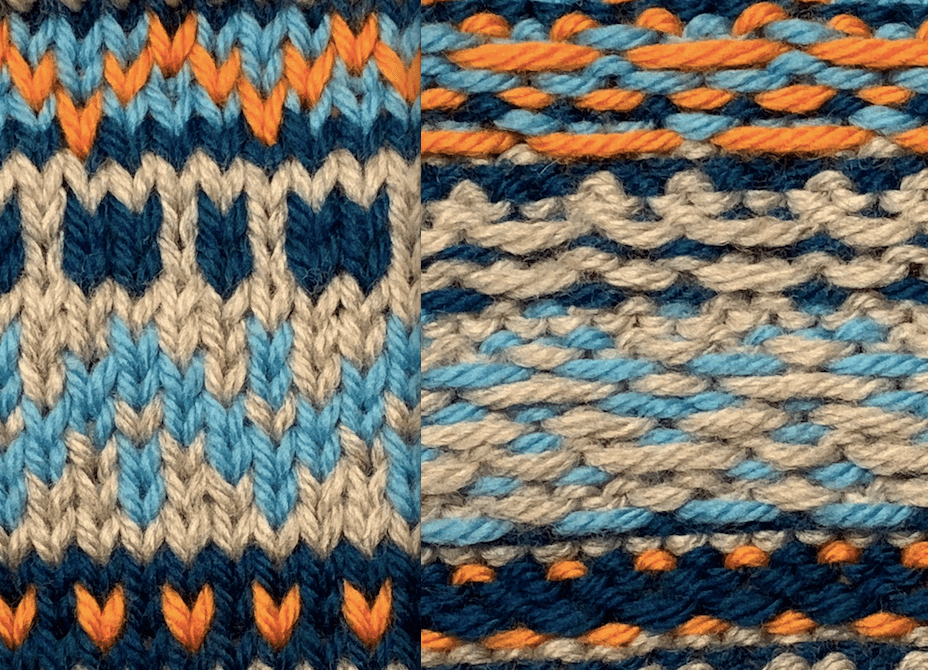
Miss: A "miss stitch" or float is a strand of yarn that extends horizontally across the back of the fabric instead of being worked into a stitch. It occurs when a needle holds its existing loop and does not form a new loop from a specific color or strand of yarn during a row or round.
Transfer: This operation moves all loops held on a needle to the corresponding needle on the opposite bed. Transfers enable stitches to be repositioned between beds and are fundamental for shaping, stitch manipulation, and the creation of complex structures.
Combined with racking—the lateral offsetting of one needle bed relative to the other—transfers can also be used to move stitches sideways along the fabric.
Racking in machine knitting refers to the process of changing the alignment of the needles on the needle beds by shifting the position of one needle bed sideways.
In the Kniterate, the front needle bed has a fixed position, whereas the rear needle bed can shift up to 4 positions in each direction. In the neutral position, that we refer to as 0.0, the needle beds are aligned with the needles facing each other. When two facing needles come out in a rack integer position (0.0, 1.0, -2.0, etc.) needles collide, as seen below.
The needle bed can also be racked by half points. When we have a 0.5 rack, the alignment of the needles is interleaved and this allows to work with all of them without them interfering with each other.
Racking is commonly used, especially in transfer operations. It’s also necessary when working with full-needle stitch structures.
In the images, we can see how the rear needle bed has moved 2 points to the left, i.e., it has a 2-point rack to the left.